Friday, 5 August 2022

Modern Table Top Games are Broken


I was playing yet another new set of wargaming rules recently published by Osprey and after a handful of turns I realised I could predict the outcome of the game; the next two hours were merely an exercise in rolling dice.

Modern wargaming rules are frequently well written, include many illustrations and use clever game mechanisms to help model the period and above all, they are simple. Simple is the problem.

In the early days of table top wargames, the wargamers such as Tony Bath, Don Featherstone, Charlie Wesencraft etc. had simple generic rules such as infantry move 6 inches, cavalry 12, guns fire 24 inches, roll to hit and roll to save etc… However, the simplicity of the rules was not an issue. Wargaming involved the non-trivial task of historical research in what was a desert of tactical and operational military history source material. Buying figures was expensive; basing and painting them time-consuming. Scenery was not cheap if from model railways; alternatively took many hours if homemade. Finding opponents and travelling to meet them also took effort. Actually playing a wargame was the culmination of the many man hours; no-one was that worried about the simplicity of the game. They were just pleased to get the toys on the tabletop.

Wargames gradually increased in complexity in the 1970’s and 1980’s, with the WRG rules being classics of the era. The latter took time to study and table top battles were complex events that precluded simple mathematical projections or generalisations that could predict the outcome. The soundest strategy with such rules was usually to apply historical tactics. Of course, the complexity of the games meant most players played a limited number of sets of rules that they gradually became masters of.

The simplicity of modern rules means that there are certain winning tactics, that seem to apply to many of these sets, such as:

  1.  More dice- the essence of winning is to get into positions to roll more dice than your opponent e.g. attacking an enemy unit coming around impassable terrain by two or preferably three units.
  2. An extension of the above is to attack from the flank, whilst also attacking from the front.
  3. Massed artillery batteries work in all periods. Rules allow single pieces of artillery to have an impact, but if you have multiple batteries firing at one target, the enemy unit routinely becomes combat ineffective in a few turns.
  4.  In games that give a player the number of dice for their actions based on the number of units, the strategy is to generate a few really low points cost units just to get more dice than your opponent. More dice for movement makes your army more agile.
  5. In games where an army routs when it looks x number of units, the aim is always to attempt to kill the enemy’s weakest units, as they are the easiest to kill. Avoid the guards or elite or veterans, aim for the militia or novices.  
  6. There seem to be simple game strategies that work irrespective of historical period, scale of figures or set or rules.

Of course, the more dice that are rolled in a game, the more chance of the law of averages applys and the easier it is to predict the outcome. If rules are too simple, is easy for players to project the likely outcome of the game after just a few moves, reducing the excitement that is an essential part of engaging players in a wargame.

Perhaps I am approaching the games with the wrong mindset. Instead of crunching the maths, I should view the toys as real, the battle as history and consider how a historical commander would approach the problems. Don Featherstone said you do not need rules to recreate history, just a player who plays historically.

Tuesday, 26 April 2022

Matrix Games Come of Age


“Does anybody know when the Geiger counter were last serviced?”

The war in the Ukraine has changed the discussion of modern warfare to include the use of nuclear weapons. An option for Russia is to use nukes to try to introduce shock and awe into the campaign, to turn Ukraine into a failed state and/ or to shock NATO into not supplying more munitions. This does not suggest the idea is sensible, but it is possible. Russia has them and Putin might order their use.

When Putin said he was putting the Russian nuclear forces on “special alert” a lot of things starting happening in the UK, including wargames. After the initial shock, bewilderment and checks whether Putin’s words were just fake news, local authorities started to leap into action (relatively speaking as local authorities are somewhat ponderous concerns). They started asking questions and finding old dusty plans on the shelves at the back of the archives. “How long does fallout last for?” “Where can we house a hundred thousand refugees?”. Local authorities are starting to consider questions from the last Cold War in some hasty exercises.

Our armed forces have also reacted; submarines went to sea. Establishment guards had their pistols put back in the armoury’s and replaced with assault rifles (plus 80 rounds). They even went to the firing ranges to zero their weapons and put some rounds down. Pistols look good, are nice and light, but do not cut it if you think enemy special forces might actually assault your position.

On the wargaming front, a lot has been happening as well. The method of Matrix Games has been challenged on the grounds of the lack of scientific rigour (not enough rules, maps, hexes, combat results tables etc…), but also by those who prefer unstructured discussions as the path to understanding (all wargames are rubbish brigade). The academic evidence is that the various variants of matrix games help impose a structure on narrative gaming, and are therefore better than unstructured narrative games.

Despite the detractors, some hastily developed matrix games are being used. They are fast to develop and take less than 2 hours to play. Useful to crystallise the stakeholders aims and objectives. Scenarios rotate around how NATO should react to: nukes being used in Ukraine, nukes being used adjacent to the Polish border with fallout over NATO member’s territory, a nuke being dropped in the North Sea, Wolverhampton being destroyed etc…

Reality will always different from any wargame, so how are they useful?

1.       Playing them iteratively develops a playbook of options that can be used in such crises.

2.       It builds the relevant language of conflict amongst the advisors.

3.       It develops the crises team in time efficient manner.

4.       It practises the decision maker’s advisors with unfamiliar scenarios.

5.       It can also be used to signal Russia about bad things that would be triggered by their actions.

In short, playing some Matrix Games increases the change of the right people making the best choices in incredibly difficult situations. As always, though, so much depends on the quality of players and facilitators. Who would have thought that a method of gaming in the hobby space some 34 years ago would make the transition to the professional space, and is a (small) part of our conflict response? Matrix Games have come of age.

Friday, 18 March 2022

Ukraine 2022- Why Are Our Wargames Wrong?


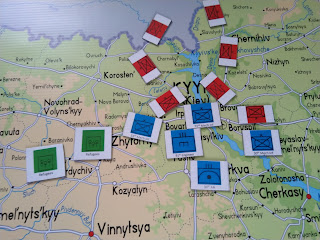
Some weeks before the war, I designed a wargame about the forthcoming war. It was a manual multi-player solo wargame with all the players on the Russian side. The game was simplistic and focussed on strategic and operational level decisions; there was no element of tactical. To be clear the game was for research purposes, to encompass a complex situation in a single model combining ORBATs, time, space, terrain and cyber; i.e. a wargame.

I have studied the development of wargaming for some decades and so when I presented a session at Connections UK in 2018, Evaluating Wargaming v the Ukraine Experience 2014-15, I was not totally surprised at the negative reaction of some professionals to my work. Having talked to senior figures in the Ukraine military who were in the war 2014/15, I identified various issues with our wargames that were designed prior to the war. Basically, our wargames got it wrong. I then went on to publish a referred journal article with my evidence and submitted it for peer review in Simulation & Gaming Journal in 2020. The article demonstrated major variations in Cold War tactical games (i.e. errors), but the article then summarised the clear academic evidence demonstrating the utility of wargames.

It has quickly become apparent that the professional wargames designed about the impending conflict had got it wrong. Ukraine did not fall quickly under the onslaught of the Russian war machine. In contrast my game was reflected the pace of the actual war and the issues of taking cities. Of course, this could have been by chance (roll a 6 and your game design is right, roll 1 to 5 and it is wrong). The professional games were better designed, included current intelligence, integrated tactical into the operational model and were superior in every way; except they were wrong.

I pondered this and have discussed it with various people and have gravitated towards a potential insight. My design was based on history:

·         the rates of advance were straight out of Dupuy’s Quantified Judgement Model (his tables for this were quoted verbatim by the UK Staff College),

·         history demonstrates that urban combat is slow (so units in urban area saved against a hit on 4, 5 or 6),

·         Russian units were untried and combat ability was determined when entering combat, etc. It is very easy in operational analysis to basis a wargame design on the latest speculative intelligence.

·         Russian logistics are ridiculous.

Rowland, in The Stress of Battle, showed that weapon performance in the ranges (and by implication, the sales brochures) were an order of magnitude better than realistic field exercises (using lasers) and the latter were again an order of magnitude better than actual combat. For example, as a I sniper I get 95% hits at 300 metres on the range, in simulated combat I get 9% hits and in actual battle I get 1% hits.

My insight that is wargames about future conflict need to be informed by the current, but embedded in the realities of military history. Ignore the generals who say this war will be completely different from the last one. Do not believe the weapon sales brochures.

References

Curry J. (2020) 'Professional wargaming: a flawed but useful tool’, Simulation & Gaming, 51 (5), pp. 612-631. http://researchspace.bathspa.ac.uk/13197/1/13197.pdf